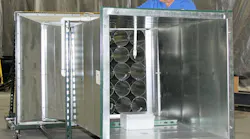
ALBUQUERQUE, N.M. - Researchers at Sandia National Laboratories are using a controlled environmental chamber to test how commercially available security cameras perform in fog and heavy rain, conditions that can impair detection of people and other objects at national security facilities.
Sandia National Laboratories is a U.S. Department of Energy (DOE) national security laboratory and federally funded research and development center (FFRDC), a government-owned, contractor-operated research institution. National Technology and Engineering Solutions of Sandia LLC, a wholly owned subsidiary of Honeywell International, manages and operates the laboratory for DOE's National Nuclear Security Administration (NNSA). Sandia's principal locations are in Albuquerque and Livermore, Calif.
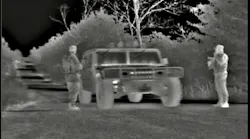
For the study, computer engineer Maria Primavera and her team installed six commercially available cameras, including a thermal camera, in the fog chamber. Researchers synchronized the cameras and timestamped their recordings so they could compare images captured at the same time under the same environmental conditions. Simultaneous testing helps limit differences that could arise if fog density or target position changed between separate camera tests.
Related: Designing secure environments with intrusion detection for defense and aerospace sites
When it rains, it pours
Sandia's recently added rain capability extends testing beyond fog. The system uses 16 rain nozzles and can produce a brief downpour using 25 to 30 gallons of water over 30 to 60 seconds. Water from ceiling nozzles collects on layers of netting, forming larger droplets before falling through the chamber. The facility also has 64 fog nozzles and adjustable LED and incandescent lighting to vary test conditions.
Sandia says the rain system was designed to target conditions outlined in MIL-STD-810H, including rainfall rates and droplet sizes, and can generate rainfall at 12 inches per hour.
Researchers also use a three-band transmissometer to measure transmission at visible, shortwave-infrared, and thermal wavelengths. By measuring signals that travel through the chamber and combining those readings with particle-sizing data, the team can characterize fog conditions and compare them with camera performance.
The team plans to analyze the synchronized recordings to establish benchmark data on camera performance as visibility deteriorates. The data could also support evaluating and training machine-learning algorithms to recognize people and other objects in degraded visual environments. Sandia has not reported comparative performance results from the camera tests.