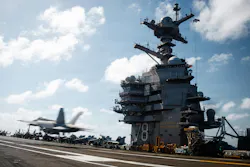
PATUXENT RIVER, Md. - The U.S. Navy is seeking industry concepts for a new generation of carrier-based uncrewed aircraft capable of performing missions ranging from strike warfare and intelligence, surveillance, reconnaissance, and targeting (ISR&T) to electronic warfare, anti-submarine warfare, logistics, and aerial refueling, as the service continues development of its Air Wing of the Future (AWOTF) family of systems strategy.
In a Sources Sought notice issued by the Navy's Portfolio Acquisition Executive (Aviation), the service said it is conducting market research to identify companies capable of designing, developing, prototyping, manufacturing, and fielding next-generation Unmanned Carrier-Based Aircraft. Information submitted by industry will help inform future requirements, investments, and acquisition decisions supporting the Navy's long-term uncrewed aviation strategy.
The solicitation places the effort within a broader family of systems construct that currently includes the MQ-25A and Collaborative Combat Aircraft (CCA). Rather than prescribing a single aircraft design, the Navy said it is interested in concepts capable of supporting carrier air wing missions as dedicated single-role platforms, multirole aircraft, or modular families of systems.
Related: Navy expands SPY-6 production as modular AESA radar architecture moves across the fleet
A flexible approach
For military and aerospace electronics suppliers, the notice provides an early look at the technologies and acquisition priorities the Navy expects will enable future carrier-based autonomous aviation. Rather than defining a specific airframe or mission-system architecture, the solicitation establishes operational objectives while allowing industry flexibility in how those objectives are achieved.
Among the primary technical requirements is compatibility with both Ford-class and Nimitz-class aircraft carriers. Proposed systems must integrate with existing launch and recovery equipment, while the Navy also expressed interest in novel concepts capable of operating from other air-capable platforms, including destroyers and expeditionary sea bases, using vertical takeoff and landing (VTOL) concepts.
The solicitation also outlines demanding operational performance objectives. For strike missions, respondents are asked to propose systems capable of delivering effects at a minimum combat radius of 1,000 nautical miles from the carrier without aerial refueling. The Navy also requests information describing how proposed systems improve combat effectiveness while maintaining compatibility with existing carrier infrastructure.
Autonomy represents another major area of interest. Rather than focusing solely on autonomous flight, the Navy asks respondents to describe both flight autonomy and mission autonomy, including capabilities such as carrier landing patterns, deck taxi operations, dynamic tasking and retasking, threat evasion, and automated aerial refueling. The emphasis reflects the service's interest in increasingly capable autonomous aircraft able to perform complex missions while operating from the unique environment of an aircraft carrier.
Related: Northrop Grumman to integrate SATURN anti-jam communications into E-2D Advanced Hawkeye
Descriptive, no prescriptive
While the solicitation does not prescribe the technologies needed to achieve those objectives, the requested capabilities would likely rely on advances in onboard processing, embedded computing, mission autonomy software, and resilient command-and-control architectures. Those enabling technologies have become increasingly important as the Department of Defense (DoD) expands the role of autonomous systems across multiple operational domains.
The notice also reinforces the Navy's emphasis on modular system architectures. Respondents are asked to describe how proposed designs align with Open Mission Systems (OMS) standards and government-owned interfaces, reflecting the DoD's broader interest in interoperable mission systems that can accommodate future capability growth and technology integration.
Beyond aircraft performance, the Sources Sought notice devotes significant attention to acquisition planning and industrial readiness. Respondents are asked to provide estimated development schedules through first flight, land-based and initial carrier "First Trap" milestones, and Initial Operational Capability (IOC), along with descriptions of Design for Manufacturing (DFM) methodologies, production scalability, Design to Cost (DTC) approaches, and sustainment planning.
The Navy is also requesting information that extends beyond traditional technical performance. Companies are asked to describe proposed non-recurring engineering cost-sharing approaches, planned capital investments, and internal research and development (IRAD) commitments to support maturation of their proposed solutions.
Collectively, the solicitation suggests the Navy is assessing a broad range of technologies and industrial capabilities needed to support future carrier-based autonomous aviation. For suppliers of embedded computing, mission processors, autonomy software, secure communications, sensors, open-system avionics, digital engineering tools, and manufacturing technologies, the notice offers insight into the engineering capabilities the service expects industry to mature as it evaluates future Air Wing of the Future concepts.
Responses are due by 5 p.m. Eastern. 13 August 2026. The Navy named Samantha Moore
as the primary point of contact for this solicitation. They can be reached via email at [email protected]. More information is available at https://sam.gov/workspace/contract/opp/1443132edc8f4940a3bc5db577cb4ed7/view.