Iveda launches gas-powered rotary-wing UAS for public safety and defense
Key Highlights
- IvedaAir features a helicopter-style design that enhances stability and payload capacity for demanding missions.
- The GX10-F100 platform can stay airborne for over 150 minutes, supporting extended surveillance and operational tasks.
- Integrated IvedaAI software enables real-time object detection, tracking, and analytics during flight missions.
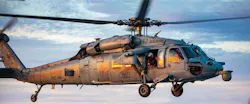
MESA, Ariz. — Iveda in Mesa, Ariz., has introduced IvedaAir, a line of autonomous rotary-wing uncrewed aircraft designed for longer-duration public safety, maritime, emergency response and defense missions.
Instead of using the multirotor configuration common to many small UAS, IvedaAir uses a helicopter-style design intended to provide greater payload flexibility and more stable operation in wind and other demanding conditions.
The line includes the gas-powered GX10-F100 platform, which Iveda says can remain airborne for more than 150 minutes. The company is pairing the aircraft with autonomous and semi-autonomous flight capabilities and its IvedaAI analytics software for real-time tracking and monitoring.
Related: Hermeus to advance high-Mach uncrewed aircraft under expanded DIU agreement
Rotary-wing design targets longer missions
Battery endurance can constrain small UAS operations when an aircraft has to cover a large area or maintain persistent surveillance. Operators may rotate aircraft or replace batteries, but both approaches introduce additional equipment and personnel requirements.
Iveda is using a different strategy with the GX10-F100. Its gasoline-powered propulsion system extends flight time beyond two hours while retaining the vertical takeoff, landing and hover capabilities of a rotary-wing aircraft.
That combination could suit missions where operators need to launch without a runway but still cover larger areas or remain over a location for an extended period.
Maritime operations are one target. Iveda envisions the aircraft supporting vessel tracking, shipping-lane monitoring and search missions over open water. On land, the company is positioning the platform for search and rescue, disaster response and infrastructure inspection.
For military users, Iveda identifies reconnaissance and supply delivery among the potential applications.
IvedaAI adds detection and tracking
The aircraft can connect with Iveda's AI software to analyze information collected during flight rather than limiting the system to remotely transmitting imagery. IvedaAir supports autonomous waypoint missions and stabilized hovering, while IvedaAI can provide object and anomaly detection and tracking. The system can transmit imagery over 4G, 5G and LTE networks and supports encrypted video and communications.
Combining autonomy with onboard or connected analytics can change the operator's role during longer missions. Instead of continuously watching a video feed for an object or event, software can help identify activity that warrants attention while the aircraft follows a planned route or maintains surveillance over an area.
The usefulness of that approach will depend partly on the sensors and payloads installed for a particular mission. Iveda has not disclosed detailed sensor configurations or the extent to which AI processing occurs aboard the aircraft rather than elsewhere in the network.
Security options target government users
Iveda is also positioning the aircraft for government procurement at a time when agencies face tighter requirements around UAS cybersecurity and supply chains.
The company says IvedaAir is compliant with the National Defense Authorization Act (NDAA) and Trade Agreements Act (TAA). Customers can also configure models with communications equipment that supports FIPS 140-3-validated cryptographic modules and components aligned with the Defense Department's Blue UAS framework.
Those options address a separate consideration from aircraft performance. Government operators continue to evaluate where UAS components originate, how aircraft transmit collected information and how communications remain protected during operations.
Federal agencies have a procurement path
Federal customers can procure Iveda's rotary-wing UAS through GlobalMed, the company's strategic partner for government sales. The aircraft are available through the Defense Logistics Agency's Tailored Logistics Support contract vehicle, giving eligible agencies an existing route to purchase the systems. Iveda says it expects to add other federal procurement vehicles.
The company is also considering a larger application for its autonomous aviation technology. Iveda says the IvedaAir program could eventually provide a pathway for converting retired full-size helicopters into autonomous aircraft, potentially extending the operational use of existing airframes.
That effort remains a future objective rather than a capability announced with the current IvedaAir line. For now, the company is entering the UAS market with a purpose-built rotary-wing platform aimed at missions where endurance, payload flexibility and autonomous sensing matter more than the compact size of a conventional quadcopter.
About the Author
Samantha McGrail
Associate Editor
Related
Voice Your Opinion!
To join the conversation, and become an exclusive member of Military Aerospace, create an account today!
 Leaders Logo
Leaders relevant to this article: