Why can’t aircraft engineers just add a bigger cooling system?
Key Highlights
- More electronics aboard aircraft generate additional heat, necessitating efficient thermal management systems that are constrained by space, weight, and power limitations.
- NASA studies pumped liquid cooling systems, which involve components like pumps and heat exchangers, highlighting the importance of system-wide integration over individual parts.
- Increasing cooling capacity often means adding hardware, which impacts aircraft weight, aerodynamics, and electrical power, requiring careful tradeoff analysis.
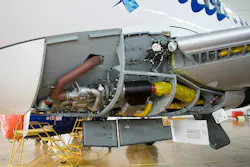
NASHUA, N.H. — More electronics aboard an aircraft can mean more heat to manage. Radar, computers, electronic warfare (EW) equipment and other systems all need electrical power, and some of that energy ultimately becomes heat.
That creates a basic requirement for aircraft designers to move enough heat away from equipment to keep it operating within acceptable temperatures.
Making the cooling system larger might sound like an easy solution when an aircraft needs more cooling capacity. On an airplane, however, cooling has to compete with other systems for limited space, weight and electrical power. NASA research treats those resources as interconnected design constraints rather than considering cooling capacity by itself.
The challenge becomes especially important as operators add more capable electronics to aircraft designed around earlier power and cooling requirements.
Aircraft have to move heat somewhere
A cooling system does not make heat disappear. It moves heat away from equipment so the aircraft can eventually reject it. NASA has studied thermal-management systems that use pumped liquid to carry heat from electrical equipment through the aircraft.
How much heat an aircraft can move depends on the complete thermal-management system rather than one component. Pumps have to circulate coolant, and heat exchangers have to transfer energy.
Increasing cooling capacity can therefore require changes beyond installing a larger heat exchanger.
More cooling adds equipment to the aircraft
Aircraft designers already work within tight limits on mass and available space. Cooling hardware has to fit within those same limits.
A liquid-cooling system can include pumps, coolant lines, heat exchangers and the fluid itself. Those components add mass, and pumps require power to move fluid through the system. A larger heat exchanger exposed to an airstream can also increase aerodynamic drag.
NASA has identified mass, power and drag as penalties associated with aircraft thermal-management systems. Its work on high-power electrified aircraft, for example, examines ways to reduce the size of fluid cooling loops because conventional systems can add considerable weight and complexity.
That means engineers cannot evaluate cooling capacity in isolation. Adding hardware to solve one thermal problem can consume resources needed elsewhere on the aircraft.
Electrical power and cooling are connected
A more capable radar or other electronic system can increase the aircraft's electrical-power demand while also producing additional heat for the thermal-management system to remove. The plane consequently has to provide both the electrical power needed to operate the equipment and enough thermal capacity to handle the resulting heat.
The F-35 offers one example. The Government Accountability Office has reported that Block 4 and later modernization capabilities require more power and cooling than originally projected. The vehicle’s power and thermal-management, fuel thermal-management and electrical-power systems work together to meet those demands.
Those relationships can make what appears to be a cooling upgrade a broader aircraft integration problem.
The heat still needs somewhere to go
How much heat an aircraft can move depends on the complete thermal-management system rather than one component. Pumps have to circulate coolant, and heat exchangers have to transfer energy.
Outside air can provide one option, but its usefulness changes with flight conditions. NASA notes that cooling performance using an aircraft's outer surface can depend on location, speed, altitude and angle of attack.
Fuel also has limits as a heat sink. As onboard heat loads increase, the fuel has to absorb more energy before reaching the engine. NASA research has examined the growing demand placed on fuel as aircraft systems produce larger thermal loads. The amount of cooling available therefore depends partly on where the aircraft can send the heat and under what conditions the system has to operate.
Existing aircraft make the problem harder
Engineers designing an entirely new aircraft can account for expected thermal loads early in development. Upgrading an aircraft already in service brings another set of constraints.
New hardware has to fit into an existing design. Changes can affect electrical systems, fuel systems, engines, maintenance procedures and support equipment. Operators also have to consider what an upgrade will cost and how easily it can be installed across aircraft already in the fleet.
GAO's work on F-35 modernization illustrates those tradeoffs. The program is examining the current thermal-management system's cooling capacity, possible upgrades or replacements and changes that may be needed in related electrical and fuel systems. GAO reported that program officials expect an entirely new power and thermal-management system would likely cost more and take longer to develop than upgrading the existing one.
Honeywell Aerospace is taking the latter approach in development work on its F-35 Power and Thermal Management System. The company is pursuing heat exchanger and liquid-cooling upgrades, software changes and turbomachine durability improvements while retaining a high degree of commonality with the existing architecture.
Honeywell says that commonality will allow the upgrades to use much of the production, logistics and sustainment infrastructure already supporting the existing system.
About the Author
Samantha McGrail
Associate Editor
Related
Voice Your Opinion!
To join the conversation, and become an exclusive member of Military Aerospace, create an account today!
 Leaders Logo
Leaders relevant to this article: