How does mixed reality help aerospace engineers design aircraft?
Key Highlights
- Mixed reality combines digital content with physical environments, allowing engineers to experience designs at full scale and in context.
- These technologies facilitate faster design iterations and early detection of potential problems, reducing reliance on time-consuming physical mockups.
- NASA, Airbus, and other aerospace leaders are leveraging virtual and augmented reality to evaluate human factors, cabin layouts, and system operability early in development.
- Immersive environments help identify ergonomic and usability issues that might be overlooked in traditional geometric models.
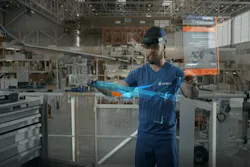
NASHUA, N.H. — Engineers can examine an aircraft or spacecraft long before the first piece of hardware exists. Computer-aided design models show dimensions and components, simulations can predict how systems will behave and digital mockups let teams work through a design before manufacturing begins.
Mixed reality gives engineers another way to work with that information by combining digital content with a person's view of or interaction with a physical environment. Instead of viewing a three-dimensional model on a conventional screen, they can experience a design at human scale and see digital information in the context where someone would eventually use it.
Simon Yuen, chief technology officer at Flightbeam Studios, said augmented and mixed-reality systems are changing how people interact with information in physical environments.
“These technologies are allowing us to prototype Human-Machine Interface (HMI) that genuinely augment the human experience,” Yuen said.
This does not replace engineering analysis or physical testing, but it can move some design questions earlier in development.
Related: GA-ASI demonstrates aircraft passive sensing for CCA teaming
Engineers can step inside a design
A three-dimensional model contains information about the shape and arrangement of a system, but how engineers interact with that model can affect what they notice.
In an immersive environment, a cockpit, cabin or spacecraft interior can appear at full scale around the person evaluating it. That gives engineers another way to consider where equipment sits, how much room exists around it and how a person would interact with the proposed layout.
NASA already uses virtual reality alongside CAD, prototypes and full-scale mockups to evaluate human spaceflight systems. Similarly, Airbus' Customer Definition Centre uses virtual reality and physical mockups to evaluate cabin configurations. In one example, an airline used the tools to examine whether a proposed door-zone arrangement left enough clearance for passengers and cabin crew.
Changes do not have to wait for another mockup
Immersive tools can also change how quickly teams evaluate an early design.
A physical mockup takes time and materials to build. A digital model can change without rebuilding the physical structure around it. Engineers can adjust a component or layout and then examine the revised configuration in an immersive environment.
Yuen sees that shorter cycle as one of the technology's useful applications. “As technology evolves, rapid prototyping cycles get faster, enabling quicker development and earlier empirical validation,” he said.
Airbus has developed mixed-reality tools that allow users in different locations to examine aircraft cabin configurations together. That does not mean every digital change is ready for production, but it gives teams another opportunity to identify design problems before they commit to hardware.
Human factors can enter the process earlier
Aircraft and spacecraft ultimately have to work around people. A technically sound layout can still create problems if a pilot struggles to interpret a display or a crew member lacks enough room to complete a task, for example.
Those issues are difficult to reduce to geometry alone. NASA says human-systems teams use virtual and augmented reality early in development to evaluate usability, operability and maintainability. The agency notes that changes become more expensive and disruptive as a space system moves further into implementation.
Human factors also matter when the immersive technology itself becomes part of the interface. The FAA studies how advanced and immersive technologies affect human performance and has examined AR and VR for aviation maintenance and training. Its research considers how people interact with new systems rather than assuming additional information automatically improves a task.
Yuen sees mixed reality as a way to place information into the environment where a person needs to interpret it. “Adding that digital layer lets individuals access real-time data without being in the same physical space,” he said.
Virtual hardware still has to become real hardware
Immersive design does not eliminate the rest of aerospace development. NASA engineers working with mixed-reality tools have described using VR to work through iterations before moving to physical models.
A virtual environment can help an engineer discover that a component is difficult to reach or that a proposed cabin arrangement needs more space. It cannot by itself establish that hardware will withstand vibration, temperature, structural loads or years of operation.
The advantage comes earlier. Engineers can ask more questions of a design before manufacturing makes those questions harder and more expensive to answer.
About the Author
Samantha McGrail
Associate Editor
Related
Voice Your Opinion!
To join the conversation, and become an exclusive member of Military Aerospace, create an account today!
 Leaders Logo
Leaders relevant to this article: