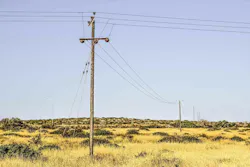
WASHINGTON — The Federal Aviation Administration (FAA) still relies on copper telecommunications lines to connect parts of the nation's air traffic control system, even as providers shift toward newer, higher-capacity networks.
The aging infrastructure has drawn renewed attention following a nationwide ground stop on Nov. 13, when network problems disrupted communications at 17 of the FAA's 22 air route traffic control centers.
Investigators are examining equipment involved in a copper-to-fiber transition, although they have not established the cause of the disruption. The incident raises a broader question about the technology supporting U.S. air traffic control and why replacing it has taken so long.
Related: FAA investigates network failure that grounded flights nationwide
How does the FAA use copper communications lines?
Copper lines carry voice communications and operational data between FAA facilities, including radar installations, radio systems and air traffic control centers. These connections help deliver radar information to controllers and support radio communications between pilots and air traffic personnel.
Some of these connections use time-division multiplexing (TDM), an older technology that divides a communications channel into time slots so multiple signals can travel over the same connection. Unlike modern Internet Protocol (IP) networks, which transmit information in packets, traditional TDM systems reserve transmission capacity for individual communications channels.
The FAA continues to use these connections because many existing systems were designed around older telecommunications interfaces. Replacing the copper wiring alone does not eliminate the need to update or adapt the equipment connected to it.
Why hasn't the FAA replaced the older technology?
The FAA must keep existing communications services operating while technicians install and test replacement equipment. Another challenge is that telecommunications providers are discontinuing support for older TDM services. As those services disappear, the FAA must move affected systems to newer connections or risk losing access to the circuits they depend on.
Older equipment also requires continued maintenance. Some components have reached or are approaching the end of manufacturer support, making repairs and replacement parts increasingly difficult to manage.
How is the FAA modernizing its communications network?
In September, the Government Accountability Office reported that the FAA had replaced 2,560 of its 5,170 targeted copper lines as of May 2026. The agency is also moving nearly 30,000 services to IP-based networks. Fiber carries data using light rather than electrical signals and generally supports greater bandwidth over longer distances than traditional copper connections.
The Transportation Department reported in November that approximately 70% of the targeted telecommunications connections had transitioned to fiber, wireless or low-Earth-orbit satellite connectivity.
The FAA must test how newer connections perform with existing air traffic control systems before putting them into service. The agency plans to complete the remaining copper-line replacements by December 2028 as part of its broader air traffic control modernization program.