BAE Systems

11487 Sunset Hills Rd
Reston, VA 20190
United States
703-367-4615
703-367-3642

More Info on BAE Systems

Develops and produces an array of space-mission solutions from radiation hardened integrated circuits, to single-board radiation hardened computers, to complete space payloads.

Articles

A Marine Corps aviation ordnance system technician loads a 2.75-inch rocket configured with Advanced Precision Kill Weapon System II at Marine Corps Air Station Yuma, Ariz., in 2018.
The prototype counter-uncrewed 2.75-inch rocket is to deploy from helicopters and fixed-wing aircraft -- particularly the Air Force F-16 jet fighter.
ID 354603274 | Ai © Dzmitry Auramchik | Dreamstime.com
AI can be vulnerable to an adversary's taking control of its data input, which can lead to data poisoning, physically constrained adversarial patches for evasion, and model stealing attacks.
BAE Systems engineers will develop counter-AI techniques, tools, and technical competency to assess AI-enabled battlefield systems.
An Army M109A7 Paladin fires a round during Operator New Equipment Training at Fort Hood, Texas, last August.
Upgrades enable the M109A7 to keep up with fast-moving M1 Abrams main battle tanks and M2 Bradley Fighting Vehicle armored personnel carriers.
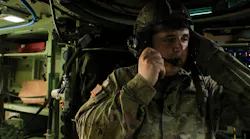
A U.S. Army combat medic relays commands to the driver of an Armored Multi-Purpose Vehicles (AMPV) at Fort Stewart, Ga., in May 2024.
AMPV armored combat vehicle comes in five variants: general purpose, mission command, mortar carrier, medical evaluation, and medical treatment.
A U.S. Marine Corps amphibious combat vehicle transits into the well deck of the Wasp-class amphibious assault ship USS Boxer (LHD 4) while conducting launch and recovery operations last September.
ACVs are wheeled armored combat vehicles that to move Marine Corps infantry from ships offshore to fight their way onto invasion beaches.
A U.S. Army soldier uses a GPS camera to document a culvert during a patrol in Afghanistan in 2010.
MGUE Inc 2 seeks to improve security, resilience, and performance of military GPS receivers by adding advanced M-Code capability and jam resistance.
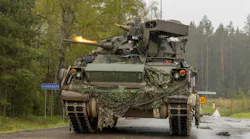
The U.S. 7th Cavalry Regiment starts a simulated firefight while in a M2A4 Bradley Fighting Vehicle during Exercise Hedgehog 25 near Camp Reedo, Estonia, last May 2025.
Bradley protects warfighters inside from small arms fire, while its 25-millimeter chain gun provides firepower to counter many battlefield threats.
A U.S. Marine aviation ordnance system technician loads a 2.75-inch rocket configured with Advanced Precision Kill Weapon System II into an LAU-68 F/A rocket launcher at Yuma Marine Corps Air Station, Ariz., last March.
The APKWS add-on kit turns a standard unguided 2.75-inch 70 millimeter rocket into a precision laser-guided munition for low-cost surgical strike.
U.S. Marines launch an ACV last month during training on Marine Corps Base Camp Lejeune, N.C.
The Marine Corps could end up purchasing as many as 204 vehicles over the next few years to outfit some of its 10 amphibious assault companies.
A 3rd Infantry Division Armored Multi-Purpose Vehicle drives off of a barge during a wet-gap crossing exercise on Fort Stewart, Ga., in 2021.
The AMPV armored combat vehicle has several electronic subsystems that involve communications, situational awareness, and command and control.

Buyer’s Guide Listing Information

Click here for listing information and directions on how to add or update your company.

Request More Information From BAE Systems

By clicking above, I agree to Endeavor Business Media's Terms of Service and consent to receive promotional communications from Endeavor, its affiliates, and partners per its Privacy Notice. I also understand my personal information will be shared with the sponsor of this content, who may contact me about their offerings per their privacy policy. I can unsubscribe anytime.

Additional content from BAE Systems

The BAE Systems Dual Band Decoy (DBD) towed EW system helps protect U.S. and allied combat jets from radar-guided anti-aircraft missiles.
Dual-band radar is particularly difficult to jam, and poses a serious threat to U.S. aircraft that must operate in contested airspace.
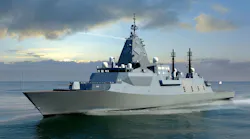
The future Australian Hunter-class frigate will receive the BAE Systems OE-120 circular shipboard antennas for identification-friend-or-foe (IFF), secondary surveillance radar, and air traffic control radar applications. The first ship is scheduled for commissioning in 2032.
Shipboard radar antennas handle surveillance, IFF, and air traffic control for U.S., Australian, and Japanese surface warships.
ID 293416438 © Ian Lott | Dreamstime.com
The future Nuclear-Armed, Sea-Launched Cruise Missile-Nuclear (SLCM-N) will launch from surface ships like the destroyer USS Paul Ignatius (DDG 117), shown here.
The SLCM-N submarine- and ship-launched cruise missile is to be the first new U.S. nuclear weapon since the end of the Cold War.
U.S. Army National Guard artillerymen fire a M109A7 Paladin self-propelled howitzer at Fort Bragg, N.C., last March.
The M109A7 has a state-of-the-art digital backbone and power generation capability, and can fire high-explosive shells or battlefield illumination.
ACVs are wheeled armored combat vehicles able to move Marine infantry warfighters from ships offshore to fight their way onto invasion beaches.
The BAE Systems Advanced Survivability Pod will help protect the Navy P-8A Poseidon maritime patrol aircraft from radar-guided missiles.
EW pod offers multi-spectral threat detection, countermeasures, sensor-fusion, situational awareness, and route planning for aircraft survivability.
The BAE Systems Marine Corps Amphibious Combat Vehicle can accommodate new capabilities as enabling technologies evolve.
The ACV is designed to accommodate new capabilities like reconnaissance sensors, electronic warfare (EW), anti-air weapons, and uncrewed aircraft.
U.S. Army mechanized cavalry are escorted by observer controllers after completing field testing of the Armored Multi-Purpose Vehicle (AMPV).
The AMPV is to replace the Army’s Vietnam-era M113 family of combat vehicles, and will back-up the BAE Systems M2A3 Bradley Fighting Vehicle.
The BQM-34S's large payload capacity make it useful for fleet training and weapon system research, development, test, and evaluation
The subsonic BQM-34S Firebee aerial target is recoverable, remote-controlled, and can fly as fast as 0.9 Mach and altitudes from 10 to 45,000 feet.
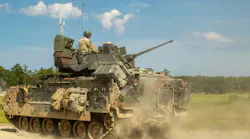
Soldiers operate an M2A4 Bradley Fighting Vehicle during an exercise last year at Fort Stewart, Ga., which required them to maneuver vehicles and fire live rounds.
The Bradley is a totally digital, full-tracked, medium armored vehicle that provides cross-country mobility, mounted firepower, and communications.
ID 285860587 | Ai © Altitudevs | Dreamstime.com
Extreme-temperature pressure sensors can withstand the heat of jet engines
BAE Systems will design and build a new pressure sensor module -- consisting of an integrated transducer and signal-conditioning microelectronics.
bae_4_nov
The RAD510 embedded computing board offers three times the performance capability of its predecessor, supporting critical space missions.