Textron, Merlin explore autonomous SkyCourier for contested logistics
Key Highlights
- The project combines Textron's SkyCourier airframe with Merlin's autonomous flight system to create pilotless military cargo aircraft for challenging environments.
- Design innovations include a forward-loading cargo architecture, a large nose opening, and aircraft kneeling to improve cargo accessibility at austere sites.
- Removing the cockpit increases cargo space and allows reconfigured internal layouts, optimizing the aircraft for logistics missions.
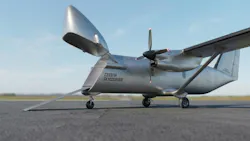
NATIONAL HARBOR, Md. - Textron Aviation and Merlin are exploring how to adapt an existing cargo aircraft for autonomous military logistics, combining the Cessna SkyCourier with Merlin Pilot autonomy in a concept designed for resupply missions in contested and austere environments.
The concept aims to fill a logistics gap between small tactical cargo drones and larger military airlifters. Rather than developing a clean-sheet autonomous aircraft, the approach uses the SkyCourier's existing airframe, production infrastructure, and cargo-handling capabilities as a starting point for exploring pilotless or pilot-optional operations.
Designing cargo aircraft around autonomy
The SkyCourier already provides much of the physical capability the concept would need for military logistics. Textron describes the freighter as capable of carrying 6,000 pounds of payload and accommodating three LD3 containers. The aircraft has a published maximum range of 940 nautical miles and 884 cubic feet of cargo volume.
The SkyCourier received Federal Aviation Administration (FAA) type certification in March 2022, with first deliveries following two months later. Textron subsequently introduced a gravel-kit option that enables the aircraft to operate from unimproved runways.
Related: Textron Aviation delivers first Cessna Citation Ascend
Merlin says Merlin Pilot has been demonstrated on the Cessna Caravan, Beechcraft King Air, de Havilland Twin Otter, Rutan Long-EZ and Cozy Mark IV, and that the company is integrating the system onto the KC-135 for the U.S. Air Force and C-130J for U.S. Special Operations Command.
Merlin says its system is designed to provide autonomy from takeoff to touchdown. The company also says Merlin Pilot has accumulated hundreds of hours of autonomous flight.
Removing the cockpit
The concept also goes beyond simply installing autonomous flight controls on an existing aircraft. Textron and Merlin are examining how the absence of an onboard crew could let the aircraft be configured differently for cargo operations. Design concepts include a forward-loading cargo architecture that would replace conventional cockpit volume with additional cargo space and provide direct access through a large nose opening.
The companies are also exploring aircraft kneeling capability and integrated loading systems intended to improve cargo accessibility and handling at austere locations.
Related: Merlin's self-flying Cessna begins testing for FAA validation
The proposed configuration could change more than the way the aircraft is flown. Removing the requirement to accommodate a pilot could allow engineers to reconsider the arrangement of the forward fuselage, cargo-loading system, and internal volume.
A conventional cargo aircraft must devote part of its structure, systems, and usable volume to the flight crew and associated cockpit functions. An aircraft designed from the outset around autonomous operation could allocate more of those resources to cargo handling, mission equipment, or other requirements.
The SkyCourier UX concept remains exploratory, so the proposed forward-loading and kneeling configurations should not be considered established production features of the SkyCourier.
A production aircraft as an autonomy platform
The existing SkyCourier provides a mature aircraft architecture from which to investigate those changes. Textron describes the SkyCourier as a twin-engine, high-wing turboprop designed for air freight, passenger and special-mission operations. The freighter is powered by two Pratt & Whitney Canada PT6A-65SC engines and uses Garmin G1000 NXi avionics.
Textron has also been expanding the SkyCourier's military relevance. In April, the company announced its first military order for the aircraft, describing the purchase as the launch of the SkyCourier into the global defense market.
Potential missions identified for the UX concept include hub-to-spoke distribution, resupply of expeditionary bases, transportation of mission-critical repair parts and medical supplies, and support for island and remote-airfield operations.
The SkyCourier UX remains a concept, and the autonomous configuration would require its own engineering, airworthiness, and certification work. The proposed aircraft would also require appropriate communications, command-and-control, mission-management, and operational procedures for military use.
About the Author
Jamie Whitney
Editor-in-Chief
Jamie Whitney joined the staff of Military & Aerospace Electronics in 2018 and oversees editorial content and produces news and features for Military & Aerospace Electronics, attends industry events, produces Webcasts, and oversees print production of Military & Aerospace Electronics.
Related
Voice Your Opinion!
To join the conversation, and become an exclusive member of Military Aerospace, create an account today!
 Leaders Logo
Leaders relevant to this article: