Airbus A350 breaks world record with 24-hour nonstop flight
Key Highlights
- The flight crossed three continents and two oceans, with 13 people aboard.
- Guinness World Records recognized the journey as the longest flight by distance for a commercial airliner.
- Airbus designed the test sector to last at least 23 hours, matching or exceeding planned Qantas routes.
- Qantas has ordered 12 A350-1000ULR aircraft for nonstop Sydney–London and Sydney–New York services.
- The first aircraft is scheduled for delivery in April 2027, ahead of planned commercial service later that year.
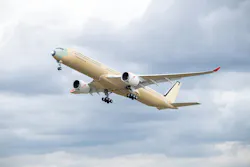
TOULOUSE, France — An Airbus A350-1000ULR, short for Ultra-Long Range, has set a world record after flying nonstop from Melbourne, Australia, to Toulouse, France. The aircraft traveled 12,503 nautical miles, or approximately 14,389 statute miles, during a flight lasting 24 hours and 24 minutes.
The flight was part of a testing program for an aircraft that Qantas plans to use on some of the world's longest passenger routes. Airbus announced Nov. 9 that Guinness World Records recognized the flight as the longest by distance for a commercial airliner.
The record-setting flight took place July 27-28, with aircraft data independently validated by the International Aeronautical Federation and flight-tracking service Flightradar24.
Related: Airbus brings digital pilot training tools Into Skywise portfolio
How did the Airbus A350 fly for more than 24 hours?
The Airbus A350-1000ULR, operating under the call sign AIB35LR, departed Melbourne at 5:27 p.m. local time on July 27 and arrived in Toulouse at 9:51 a.m. local time the following day. Instead of following the shortest route between the two cities, the aircraft took a longer path to meet the requirements of its flight test program.
After departing Melbourne, it passed over Sydney and headed northeast across the Pacific Ocean toward Los Angeles. It crossed the international date line, continued across North America and the Atlantic Ocean, then traveled over London before reaching Toulouse.
The route took the vehicle across three continents and two oceans. Thirteen people were on board, including three Airbus flight test pilots, two Qantas pilots, five Airbus flight test engineers, two Airbus design engineers and a representative of the International Aeronautical Federation. They experienced two sunrises and two sunsets.
The flight also fulfilled a specific requirement of Airbus' development program. Engineers needed to complete a sector with a block time of at least 23 hours, measured from the aircraft's departure from its parking position to its arrival at the destination stand.
That requirement allowed Airbus to look at the aircraft during a flight lasting as long as, or longer than, the commercial routes Qantas intends to operate.
What makes the A350-1000ULR different?
One of the most important changes to the A350-1000ULR is the addition of a rear center fuel tank integrated into the plane's structure. Aircraft range depends on many factors, such as fuel capacity, weight, aerodynamic efficiency and operating conditions. For ultra-long-haul flights, carrying enough fuel is particularly important because the aircraft must be airborne for nearly an entire day.
The additional tank boosts the A350-1000ULR's range by about 1,000 nautical miles compared with the standard aircraft, according to Airbus. That extra capacity is central to Qantas' plans to operate nonstop flights from Sydney to London and New York. Both routes cover distances approaching 10,000 nautical miles and could keep passengers and crews in the air for as long as 22 hours.
The record flight exceeded those planned distances, so Airbus could demonstrate the aircraft's extended-range capability before it enters commercial service.
“Flying 12,503 nautical miles non-stop, we have fully proven the aircraft's capability to fulfill its mission,” said Lars Wagner, CEO of commercial aircraft at Airbus.
Why is Qantas developing Project Sunrise?
Qantas launched Project Sunrise to establish nonstop passenger service between Australia's east coast and major destinations that have traditionally required a connecting flight. Flights between Sydney and London have traditionally required a stop, but Project Sunrise would allow passengers to complete the journey without changing planes.
Flying for up to 22 hours also places more demands on aircraft range, fuel planning and long-duration operations. Although the record shows the vehicle’s ability to complete an unusually long flight, regular passenger operations will involve additional considerations, including passenger loads, weather, and airline scheduling.
Related: What was the fastest commercial passenger plane?
When will Qantas begin using the A350-1000ULR?
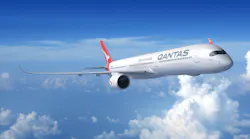
Qantas has ordered 12 A350-1000ULR aircraft for Project Sunrise. Airbus said the first aircraft is scheduled for delivery in April 2027, with commercial service between Sydney and London expected to begin later that year.
The airline also has 12 standard A350-1000 aircraft on order for other long-haul routes. The A350-1000ULR becomes the fourth passenger version of the A350 family, joining the A350-900, A350-900ULR and A350-1000.
Airbus is also developing the A350F freighter, which made its first flight Sept. 29 and entered a nine-month flight test program. The manufacturer reported 1,628 orders for the A350 family from 70 customers as of the end of October 2026. More than 740 aircraft were already operating with 42 airlines, primarily on long-haul routes.
About the Author
Samantha McGrail
Associate Editor



Voice Your Opinion!
To join the conversation, and become an exclusive member of Military Aerospace, create an account today!
 Leaders Logo
Leaders relevant to this article: