What was the fastest commercial passenger plane?
Key Highlights
- Concorde cruised at approximately 1,350 mph, or Mach 2, at altitudes approaching 60,000 feet.
- A British Airways Concorde set a New York–London record of 2 hours, 52 minutes and 59 seconds in 1996.
- The Tupolev Tu-144 reportedly reached Mach 2.4 but carried passengers for less than a year.
- Concorde retired in 2003 amid high operating costs, noise restrictions and declining demand.
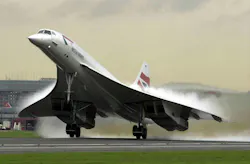
NASHUA, N.H. — Passengers flying from New York to London today can expect to spend a little over seven hours in the air. For nearly three decades, however, travelers could make the trip in roughly half the time aboard Concorde. This supersonic airliner could fly more than twice the speed of sound.
Britain and France jointly developed Concorde, and it entered passenger service in January 1976. British Airways and Air France operated the aircraft until 2003. Concorde became the best-known supersonic passenger aircraft, although it did not hold the record for the highest speed achieved by an airliner. That distinction belongs to the Soviet-built Tupolev Tu-144, which flew faster but carried passengers for a much shorter period.
Related: FAA proposes new path for overland supersonic flight
How fast could Concorde fly?
Concorde cruised at approximately 1,350 miles per hour (mph), or Mach 2, at altitudes approaching 60,000 feet. Mach numbers compare an aircraft's speed with the local speed of sound, which changes with atmospheric conditions.
The aircraft also set a transatlantic speed record. On Feb. 7, 1996, a British Airways Concorde flew from New York to London in two hours, 52 minutes and 59 seconds. Despite its speed, Concorde had a relatively small cabin and limited seating capacity, carrying only about 100 passengers.
What made Concorde faster than other passenger planes?
Concorde's engines, wings and fuselage were designed to handle the demands of supersonic flight. Four Rolls-Royce/SNECMA Olympus 593 turbojet engines provided propulsion. The engines used a system called reheat, or afterburning, which introduced more fuel into the exhaust stream to boost thrust. Concorde used this extra power during takeoff and acceleration through the speed of sound.
Its long, narrow fuselage helped reduce aerodynamic drag. The aircraft also featured delta-shaped wings, which supported high-speed flight while providing lift during takeoff and landing.
Flying at supersonic speeds also created problems with heat. As Concorde moved through the atmosphere, the air around the aircraft compressed and heated its exterior. The temperature changes caused the airframe to expand, increasing its length by several inches during flight. Engineers accounted for that expansion in the aircraft's structure.
Concorde also used a specially developed white paint to help manage this heat.
Was the Tupolev Tu-144 faster than Concorde?
Yes. The Soviet Union developed the Tupolev Tu-144 during the same period that Britain and France were working on Concorde. The Tu-144 first flew in December 1968, several months before Concorde made its first flight in March 1969. It reportedly reached Mach 2.4 during testing.
Aeroflot began carrying passengers aboard the Tu-144 in November 1977 on a route between Moscow and Alma-Ata, now Almaty, Kazakhstan. Technical difficulties and limited range affected its operations, and passenger service ended in 1978.
Concorde remained in service for 27 years, operating thousands of flights across the Atlantic.
Related: How do airlines turn passenger planes into cargo aircraft?
Why did Concorde stop flying?
Concorde's speed came with considerable operating costs. Its engines consumed large amounts of fuel, and its limited seating capacity made those expenses harder to offset.
Noise also restricted where the aircraft could fly. When a plane travels faster than sound, it produces shock waves that can reach the ground as sonic booms. Restrictions on supersonic flight over populated areas therefore limited the routes Concorde could operate.
Maintenance became increasingly expensive as the fleet aged. In July 2000, an Air France Concorde crashed shortly after takeoff near Paris, killing 113 people. The accident led to the grounding of the fleet and subsequent safety modifications before flights resumed.
By 2003, declining demand had made continued service difficult to justify. Air France retired Concorde earlier that year, and British Airways operated its final scheduled commercial flight on Oct. 24, 2003.
Will commercial passenger planes fly supersonically again?
While Concorde showed that passenger aircraft could fly faster than sound, it also highlighted the difficulties of operating them commercially. Future supersonic airliners must address many of the same problems, including fuel consumption, operating costs and sonic booms. Engineers continue to look at designs that could minimize the noise associated with supersonic flight, particularly over land.
NASA's X-59 experimental aircraft is one example. Engineers used computer modeling to design its shape, which is intended to reduce the loud sonic boom typically associated with supersonic flight to a quieter thump.
No supersonic passenger aircraft currently operates scheduled commercial flights. Although the Tu-144 achieved higher speeds, Concorde remains the only supersonic airliner to operate commercial passenger service for more than two decades.
About the Author
Samantha McGrail
Associate Editor


Voice Your Opinion!
To join the conversation, and become an exclusive member of Military Aerospace, create an account today!
 Leaders Logo
Leaders relevant to this article: