Why aircraft electronics are becoming harder to cool
Key Highlights
- Modern aircraft electronics generate significant heat, requiring advanced cooling techniques to maintain performance within size and weight limits.
- Conduction cooling offers a sealed, low-maintenance solution but faces limits as processors become more power-dense, necessitating supplementary methods like forced-air or liquid cooling.
- High-altitude environments reduce air cooling effectiveness, prompting the use of liquid cooling systems that circulate coolant to manage higher heat loads.
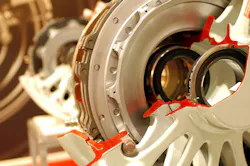
NASHUA, N.H. — Putting more computing power aboard an aircraft creates another engineering problem: the electronics have to get rid of the heat they produce.
That challenge grows as vehicles add more capable avionics, sensors and onboard computing while space and weight remain limited. Heat can eventually affect how much performance an electronic system can sustain. A processor may be capable of handling a larger workload, for example, but it cannot operate at that level indefinitely if its temperature climbs beyond its operating limits.
Aircraft make the problem particularly interesting. Electronics have to fit within strict size and weight limits while operating through changing temperatures, pressures and flight conditions. Some equipment also sits inside sealed or tightly packaged enclosures that leave little room for conventional cooling hardware.
Related: Why commercial aircraft cruise around 35,000 feet
More computing can put more heat into less space
Modern avionics may have to process information from several sensors and support more functions locally rather than sending data elsewhere for analysis.
AI and edge computing are two examples. For instance, an inspection drone may process camera imagery onboard to identify an object or defect while it flies. More capable autonomous aircraft may combine information from cameras, radar and navigation sensors to understand their surroundings and make decisions.
Handling that information aboard the aircraft can lessen dependence on a communications link, but it shifts more of the computational and thermal load onto the vehicle itself.
Conduction cooling provides a simple starting point
One established way to cool rugged electronics is conduction. Rather than moving air directly across components, a conduction-cooled system gives heat a physical path out of the electronics. Heat can travel from a processor through the circuit board and mechanical interfaces into a cold plate, which carries it farther away from the component.
This approach can work well when engineers need to keep electronics enclosed. Without outside air flowing directly through the equipment, designers can better protect sensitive hardware from dust, moisture and other contaminants.
Conduction cooling also avoids fans and some of the moving parts associated with other thermal-management systems, but the approach has limits. As processors create more heat, the thermal path has to carry a larger load. Small gaps and materials with lower thermal conductivity can make it harder for heat to move from the component to the chassis.
Air and liquid can handle larger heat loads
When conduction alone cannot remove enough heat, designers have other options. Forced-air cooling moves air across or around electronic hardware to carry heat away. This can increase heat transfer, but it also requires space for airflow and equipment such as fans or blowers. Engineers also have to think about where the heated air goes after it leaves the electronics.
Aircraft environments can complicate that equation because cooling performance changes with altitude and surrounding conditions. Air becomes less dense as altitude increases, which can minimize its ability to carry heat away. A coolant can circulate near electronic assemblies, absorb heat and carry it to another location where the aircraft can reject it.
Liquid can move more heat than air in a relatively compact system, but that capability comes with additional hardware. Pumps, tubing, connections and heat exchangers take up space and add weight. Engineers also have to account for maintenance and the consequences of a leak.
The best approach depends on the vehicle and the electronics inside it. A small uncrewed aircraft faces different constraints from a large commercial airplane, even if both need to cool increasingly capable computers.
Electric aircraft add another thermal challenge
The cooling problem extends beyond avionics. Electric and hybrid-electric aircraft add batteries, motors and power electronics that generate their own heat. Those systems may also have different preferred operating temperatures, making thermal management a larger aircraft-level problem.
A battery, for example, has to remain within an acceptable temperature range during charging, discharge and flight. Power electronics need to shed the heat they generate while converting and controlling electrical energy. Motors create another source that designers have to manage.
Because those loads can interact with the cooling requirements of avionics and other onboard electronics, engineers cannot always treat each component as an isolated thermal problem. They have to decide where heat moves throughout the aircraft, which systems can share cooling equipment and where the aircraft can ultimately reject that energy.
For electric vehicle in particular, the cooling system itself also consumes power and adds weight. A thermal-management solution that removes more heat but requires a larger pump or additional coolant can affect aircraft efficiency and range.
Cooling is moving closer to the electronics
Another way to address the problem is to shorten the distance heat has to travel in the first place. Traditional cooling methods often remove heat after it has already traveled through a component package and into a larger electronic assembly. Newer approaches can push thermal management closer to the processor or other heat-producing device.
Engineers have explored high-conductivity materials, improved thermal interfaces, microchannels and other techniques designed to draw heat away from components more directly. Removing heat near its source can help prevent a small, high-power component from developing a localized hot spot.
That becomes more important as processors become more power-dense. A system does not necessarily have to produce an enormous amount of heat overall to create a thermal problem. Concentrating that heat in a very small area can be enough.
Better cooling near the component can also give aircraft designers more flexibility farther up the system. Once heat leaves a processor efficiently, engineers have more options for transferring it through the enclosure and into the aircraft's larger thermal-management system.
About the Author
Samantha McGrail
Associate Editor
Related
Voice Your Opinion!
To join the conversation, and become an exclusive member of Military Aerospace, create an account today!
 Leaders Logo
Leaders relevant to this article: