What is an inertial measurement unit, and how does it work?
Key Highlights
- IMUs contain three accelerometers and three gyroscopes to measure motion along and around three perpendicular axes, providing comprehensive movement data.
- Accelerometers detect specific force including gravity, while gyroscopes measure angular rate, both crucial for understanding vehicle orientation and movement.
- IMUs are used across various platforms, from small drones to large aerospace vehicles, with sensor design tailored to size, accuracy, and power needs.
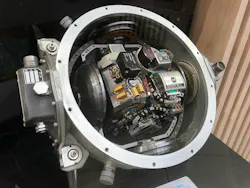
NASHUA, N.H. — An aircraft banks into a turn or a drone adjusts its position in a gust of wind. In both cases, the vehicle needs to understand how it is moving before its control system can respond.
An inertial measurement unit (IMU) provides some of those measurements. This device combines motion sensors in a compact package and sends their readings to other systems aboard the vehicle.
IMUs appear in aircraft, spacecraft, missiles, uncrewed vehicles and many other machines that need to monitor their movement. They can operate without receiving signals from GPS satellites, although they cannot determine a vehicle’s exact location on their own.
To understand what an IMU does, it helps to start with its two main types of sensors.
Related: What Radiation Test Results Tell You About IMU Reliability
What does an IMU measure?
A typical IMU contains three accelerometers and three gyroscopes. Together, they measure motion along and rotation around three perpendicular axes. Accelerometers measure specific force, which includes the effects of a vehicle’s acceleration and the support force that counteracts gravity. Gyroscopes measure angular rate, or how quickly the vehicle rotates.
The three axes allow the IMU to capture motion in different directions. An aircraft, for example, can pitch its nose up or down and yaw left or right. A three-axis gyroscope measures the rate of rotation around each of those axes.
The accelerometers provide another set of measurements. They respond when the aircraft speeds up, slows down or changes direction. When a vehicle is stationary on the ground, its accelerometers also register the force supporting it against gravity.
An IMU sends these measurements to a flight computer, navigation processor or control system. The receiving system uses them to estimate how the vehicle is moving and, depending on the available information, how it is oriented.
How do accelerometers and gyroscopes work?
An accelerometer contains a sensing element that responds to force. In a common microelectromechanical systems (MEMS) design, a tiny internal mass moves relative to the sensor housing. Electronics detect that movement and convert it into a measurement.
A gyroscope measures rotation rather than linear motion. MEMS gyroscopes often use a vibrating structure that responds when the device rotates. Other gyroscope designs use light instead of a vibrating mechanical element.
For example, fiber-optic gyroscopes send light in opposite directions through a coil of optical fiber. Rotation produces a measurable difference between the beams, allowing the instrument to calculate angular rate.
Different IMUs use different sensor designs depending on their size, cost, power and accuracy requirements. A small commercial drone may use a compact MEMS-based unit, while a larger aerospace platform may use higher-precision gyroscopes.
How does an IMU help a vehicle maintain its orientation?
Imagine a gust of wind causes a drone to tilt, and its gyroscopes measure the resulting rotation. The flight controller uses those readings, along with other sensor information, to see how the drone’s attitude is changing. It can then adjust the motors to counter the unwanted movement.
The same principle applies to larger aircraft, although their flight-control systems are more complex. Motion measurements help those systems monitor the aircraft’s response to control inputs and disturbances.
An IMU does not directly report a complete, error-free attitude. A processor must combine its sensor readings to estimate orientation. Gyroscope measurements show how orientation changes over time, while accelerometer measurements can help provide a reference to gravity under suitable conditions.
That distinction matters during maneuvers. An accelerometer responds to the combined effects of gravity and the vehicle’s motion, so a processor cannot always treat its readings as a simple indication of which way is down. Depending on the application, the system may also use magnetometers, air-data sensors, cameras or other measurements to improve its estimate.
Is an IMU the same as an inertial navigation system?
No. An IMU supplies sensor measurements, while an inertial navigation system (INS) processes those measurements to estimate a vehicle’s orientation, velocity and position. An INS starts with information about the vehicle’s initial state. It then uses gyroscope readings to track changes in orientation and accelerometer readings to calculate changes in velocity and position. The calculations continue as the aircraft moves, so the system can maintain a navigation estimate without constantly receiving an external position signal.
That capability is useful when GPS is unavailable, jammed or spoofed. However, an INS does not remain perfectly accurate indefinitely. Small errors in the sensor measurements accumulate as the navigation processor calculates movement over time. An error in orientation can also affect how the system interprets acceleration, which can boost errors in its velocity and position estimates.
Navigation systems often use reliable external measurements, such as GPS updates, to correct that drift. When those updates are unavailable, the quality of the inertial sensors and the length of the outage affect how far the estimated position may depart from the vehicle’s actual location.
Related: What happens when an aircraft loses GPS?
Why do aerospace engineers use IMUs?
Engineers select an IMU based on what the vehicle needs to measure and how accurately it must measure it. Sensor errors, vibration, temperature changes, power consumption, size and weight can all influence that choice.
A small drone and a spacecraft may both carry IMUs, but they do not necessarily need the same sensors or processing equipment. The basic function remains the same. An IMU measures acceleration and rotation; the systems connected to it use those measurements to navigate, stabilize or control the vehicle.
About the Author
Samantha McGrail
Associate Editor
Related
Voice Your Opinion!
To join the conversation, and become an exclusive member of Military Aerospace, create an account today!
 Leaders Logo
Leaders relevant to this article: